Compare Excel sheets by ID, even when rows move
An updated order export may put the same orders on different rows. Match them by Order ID before checking Amount, so a change in sorting does not become a false difference. In these fictional files, the older export is the reference and the newer one is the comparison file. You will find one changed amount and orders present in only one file. All amounts are in USD; use a consistent currency because RowKite does not convert currencies.
Download the sample files
These sample files use fictional records and contain the rows shown below. Try them first, then use the same approach with your own files.
What is in the sample files
Reference file
| Order ID | Amount | Order status |
|---|---|---|
| SO001 | 120 | Paid |
| SO002 | 80 | Paid |
| SO003 | 50 | Paid |
Comparison file
| Order ID | Amount | Order status |
|---|---|---|
| SO003 | 50 | Paid |
| SO001 | 125 | Paid |
| SO004 | 60 | Paid |
Follow these steps
Prepare two exports covering the same scope
Download the reference and comparison files below. Each has headers in the first row and text values for Order ID. For IDs such as 001, set the column to Text before entering or importing values. Use the same reporting period, currency, and definition of Amount in your own files.
Choose the files and sheets
Open the comparison workspace. Add baseline.xlsx as the Reference file and target.xlsx under Files to compare. Select the Orders sheet in both files.
Match by Order ID and compare Amount
Under Match rows by, select Order ID. Under Columns to compare, select Amount. Identical headers map automatically. These amounts are numbers, so keep the default Raw values rule.
Review the results
Click Compare files. The default Differences and needs review filter shows SO001, SO002, and SO004. Select All records to see the unchanged SO003. Moving an order to a different row does not count as an amount change.
Download the full report
Click Download Excel report to keep the summary, all comparison details, and issues. The report includes the full result, regardless of the current filter or page.
Expected results
Match rows by: Order ID. Columns to compare: Amount.
| Record | Result | What changed |
|---|---|---|
| SO001 | Changed | Amount changed from 120 to 125. |
| SO002 | Only in reference file | This order appears in the reference file, but not in the comparison file. |
| SO003 | Same | Amount is still 50. Its new row position does not affect the result. |
| SO004 | Only in comparison file | This order appears in the comparison file, but not in the reference file. |
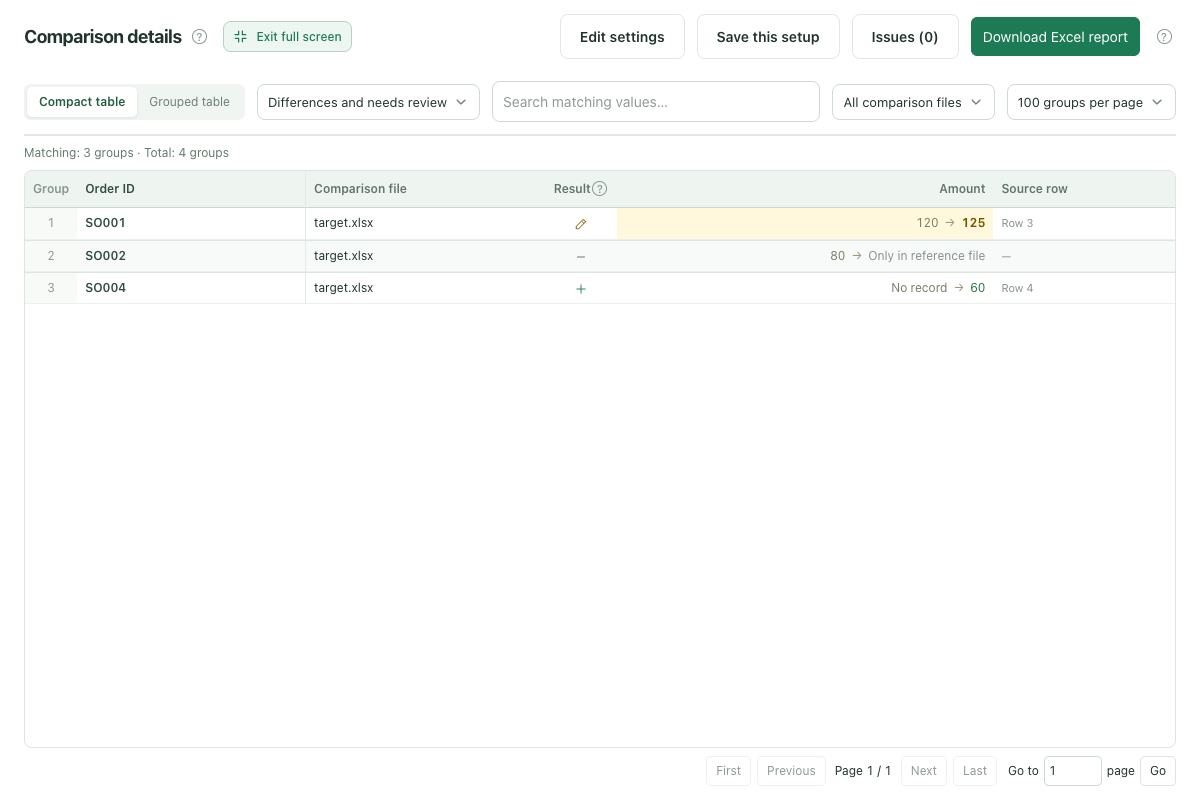 View full-size screenshot ↗
Before using your own files
- If an order has multiple line items, add a line item ID or SKU to the matching columns. Order ID alone cannot identify a unique row.
- In Raw values mode, text "001" differs from the number 1. RowKite cannot restore leading zeros or digits already lost in Excel.
- Added and missing records depend on the reference: SO004 appears only in the newer file, while SO002 appears only in the older file. Swap the files and those statuses reverse. Changed values are also read relative to the selected reference.
- Use standard .xlsx or Excel 97–2003 .xls tables. Formulas are read from their saved results; RowKite does not recalculate them.
Limits: 2–5 .xlsx / .xls files, with both formats allowed in one comparison. Use standard, unencrypted Excel 97–2003 tables for .xls. Limits are 10 MiB per file, 30 MiB total, 10,000 rows and 50 columns per sheet, and 1 million populated cells across all files. Reports are always exported as .xlsx. Refreshing, closing the page, or leaving the workspace clears the current files.
Continue with your files
Read the full guide and comparison rules · Learn how files and results are handled
Keep reading
Download sample files, follow the steps, and apply the same approach to your own records.